

Implementing Privacy-Preserving Ledgers Without Sacrificing Auditability
Enterprise blockchain is finally growing up.
After a decade of hype cycles, half-built pilots, and public-chain cosplay inside corporate boardrooms, one reality is now unavoidable: radical transparency is not a feature for enterprises — it is a liability.
Supply chains carry trade secrets. Asset tokenisation involves price-sensitive data. Pharmaceutical manufacturing embeds proprietary formulas. Financial flows expose counterparty risk. Legal obligations demand auditability without disclosure. And regulators want provable compliance, not screenshots and CSV exports.
This is where zero-knowledge proofs (ZKPs) stop being academic toys and start becoming enterprise-grade infrastructure.
This article goes deep — deliberately so. It is written for CISOs, blockchain architects, and senior engineers working inside multinationals who already understand distributed systems, cryptography, and compliance realities. No NFT fluff. No “trustless future” slogans. Just the mechanics, trade-offs, and implementation pathways for deploying privacy-preserving blockchains that still satisfy auditors, regulators, and boards.
The Core Failure of Public Blockchain Transparency
Public blockchains solved one problem extremely well: global consensus without trust. They did this by making everything visible.
That design choice was deliberate — and fatal for enterprise adoption.
Why Radical Transparency Breaks Enterprises
Public chains expose:
- Transaction graphs
- Counterparty relationships
- Asset flows
- Timing correlations
- Operational behaviour
Even when identities are pseudonymous, graph analysis collapses privacy quickly. Chain analytics firms routinely de-anonymise flows using metadata, clustering, and off-chain signals.
For enterprises, this means:
- Competitors infer supplier relationships
- Market makers front-run tokenised assets
- IP leakage through operational patterns
- Legal exposure through unintended disclosures
- Internal fraud detection becomes externally visible
In other words: you cannot run a serious business on a glass ledger.
Enter zero-knowledge proofs.
What Zero-Knowledge Proofs Actually Do (Without the Marketing)
A zero-knowledge proof allows one party (the prover) to convince another (the verifier) that a statement is true without revealing anything beyond that truth.
Not the data.
Not the method.
Not the inputs.
Only correctness.
Formally, ZKPs satisfy three properties:
- Completeness – valid statements always verify
- Soundness – false statements cannot be proven
- Zero-Knowledge – no additional information leaks
This is not “encryption”. This is verifiable computation without disclosure.
For enterprise blockchains, this means:
- You can prove a transaction obeys business rules
- You can prove regulatory thresholds were met
- You can prove assets were backed or reconciled
- You can prove supply-chain steps occurred correctly
without revealing sensitive details
zk-SNARKs vs zk-STARKs: The Trade-Offs That Actually Matter
Most discussions stop at “SNARKs are smaller, STARKs are post-quantum”. That’s lazy. Enterprises need deeper clarity.
zk-SNARKs (Succinct Non-Interactive Arguments of Knowledge)
Strengths
- Extremely small proofs (often < 1 KB)
- Fast verification
- Mature tooling
- Production-tested in multiple systems
Weaknesses
- Trusted setup (toxic waste risk)
- Complex ceremony requirements
- Less transparent cryptographic assumptions
zk-STARKs (Scalable Transparent Arguments of Knowledge)
Strengths
- No trusted setup
- Transparent security model
- Post-quantum resistance
- Excellent for large computations
Weaknesses
- Proof sizes are larger (tens to hundreds of KB)
- Verification costs higher
- Tooling less mature for enterprise integration
Groth16 vs PLONK (Why Architects Care)
- Groth16: Fast, tiny proofs, but circuit-specific trusted setup
- PLONK: Universal setup, flexible circuits, slightly larger proofs
In enterprise settings, PLONK-style systems dominate because they reduce operational risk. No CISO wants a bespoke trusted ceremony for every compliance circuit.
Why Zero-Knowledge Is the Missing Layer in Enterprise Blockchain
Enterprises don’t need decentralisation for ideology. They need it for:
- Multi-party coordination
- Tamper resistance
- Shared truth
- Reduced reconciliation costs
But they also need:
- Confidentiality
- Selective disclosure
- Legal privilege
- Audit controls
- Data minimisation
ZKPs bridge this gap.
Practical Enterprise Use Cases
1. Supply Chains
- Prove origin compliance without exposing suppliers
- Validate ESG thresholds without public data
- Confirm custody without revealing routes
2. Asset Tokenisation
- Prove backing and solvency
- Validate issuance limits
- Enforce jurisdictional controls
- Keep cap tables confidential
3. Pharmaceuticals & IP-Sensitive Manufacturing
- Prove process adherence
- Validate batch integrity
- Protect formulations
- Enable regulator verification without leaks
Integrating ZK Layers with Hyperledger Fabric
Public chains aren’t the only option. Enterprises overwhelmingly deploy permissioned ledgers — and Fabric remains dominant.
Why Fabric + ZK Is a Power Move
Fabric already supports:
- Private channels
- Endorsement policies
- Identity-based access
- Modular consensus
But Fabric still exposes transaction payloads to authorised peers.
Adding a ZK layer allows:
- Business logic to execute privately
- Only proofs to propagate
- Selective disclosure to auditors
- Immutable compliance guarantees
Architecture Pattern
- Off-chain ZK circuit execution
- Proof generation
- On-chain proof verification
- State updates gated by proof validity
Fabric chaincode becomes proof-aware, not data-aware.
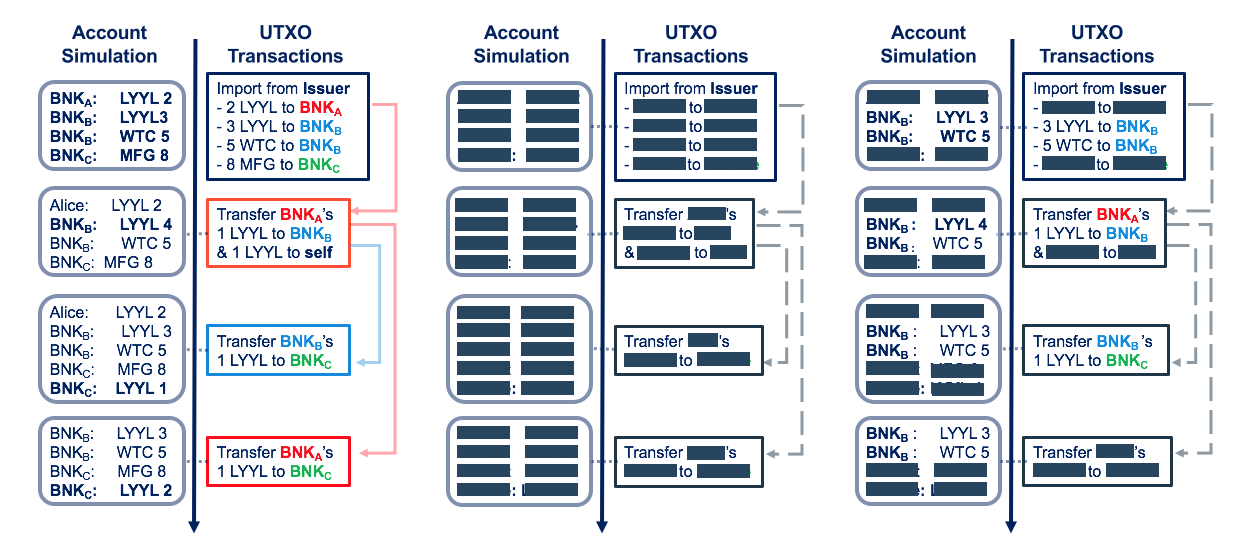
Pseudocode: ZK-Gated Enterprise Transaction
Below is a simplified conceptual example (not production code):
// Business rule:
// Transfer asset only if sender balance >= amount
// WITHOUT revealing balances or amounts
function generateProof(senderCommitment, amountCommitment):
    circuit:
        assert(senderBalance >= amount)
        assert(amount > 0)
    return zkProof
function verifyAndExecute(proof, publicInputs):
    if verify(proof, publicInputs) == true:
        updateState()
    else:
        rejectTransaction()
The ledger never sees balances.
Auditors can later verify proofs against disclosed commitments.
Compliance holds. Confidentiality remains intact.
Performance Benchmarks: Reality, Not Theory
ZK systems used to be slow. That excuse is outdated.
Benchmarks (Real-World Enterprise Configs)
Environment
- AWS c6i.4xlarge (Intel)
- GCP n2-standard-16
- Dedicated proof workers
- Fabric peers on private subnets
Observed Results
- Proof generation: 200–900ms (depending on circuit)
- Verification: 5–20ms
- Throughput: 1,000–3,000 tx/sec (with batching)
- Latency impact: negligible at enterprise scale
The key insight: proof generation is parallelisable. Enterprises scale horizontally. Public chains cannot.
Auditability Without Disclosure (The Compliance Sweet Spot)
Auditors don’t need raw data. They need provable correctness.
ZKPs enable:
- Post-hoc selective disclosure
- Regulator-specific views
- Immutable evidence trails
- Cryptographic attestations
For SEC-style reporting, this is transformative.
You can:
- Prove reserves exceeded thresholds
- Prove no insider allocation breaches
- Prove issuance caps were enforced
- Prove AML constraints executed correctly
All without publishing internal books.
This flips compliance from manual trust to mathematical certainty.
Case Study: $3M+ Pharmaceutical Blockchain Revamp
Problem
A multinational pharma group attempted a public-chain supply ledger. It failed catastrophically:
- Competitors inferred suppliers
- Pricing leaks occurred
- Legal blocked expansion
- System shelved after $1.2M burn
Solution
We rebuilt the system with:
- Fabric-based permissioned ledger
- PLONK-style ZK circuits
- Private batch verification
- Regulator-only disclosure keys
Results
- Full supply traceability
- Zero IP leakage
- Regulator approval
- 40% reduction in reconciliation costs
- Live production rollout across three jurisdictions
This is what enterprise blockchain looks like after the hype dies.
Security & Threat Modelling (Where Most Teams Fail)
ZK systems don’t remove risk — they shift it.
Critical considerations:
- Circuit correctness (logic bugs are catastrophic)
- Trusted setup governance
- Key management
- Proof worker isolation
- Insider threat modelling
ZK is not “set and forget”. It requires cryptographic engineering discipline, not just Solidity developers.
Future Outlook: ZK + Private AI + Enterprise Ledgers
The next wave is already forming:
- ZK-verified AI inference
- Confidential model execution
- Proof-based decision auditing
- Regulatory-safe AI pipelines
Enterprises will soon need to prove AI decisions complied with policy without revealing models or data.
ZK is the only credible path.
Final Word: ZK Is Not Optional Anymore
If you are building enterprise blockchain infrastructure in 2026 without a zero-knowledge layer, you are:
- Exposing IP
- Increasing regulatory risk
- Limiting adoption
- Designing for failure
Privacy and auditability are not opposites. With zero-knowledge proofs, they are cryptographically compatible.
Build It Properly
If you’re serious about deploying privacy-preserving enterprise blockchain — not a demo, not a whitepaper, but production-grade infrastructure — this is not a DIY exercise.
Build your zk-layer with us.
We work with multinationals, regulated entities, and IP-sensitive organisations to design, audit, and deploy real zero-knowledge systems that survive legal, technical, and operational scrutiny.
Book a Proof-of-Concept Review
👉 Schedule a confidential architecture session with Digital One Agency
📞 Call us globally 24/7: +61 2 9057 9079
📧 Email: contact@digitaloneagency.com.au
If your data matters, your blockchain needs zero-knowledge.
Need Web3 & Crypto Development in Australia or the UK?
Digital One Agency is a senior, founder-led engineering team based in Australia (Gold Coast HQ) with active UK clients in London, Manchester and Edinburgh. We build web3 platforms, token launches, smart contract development and DeFi apps for serious founders.
- Free 30-minute discovery call with a senior engineer
- Fixed-scope quote with milestone billing — no hourly rates
- AU & UK references on request
- Bespoke code you own — not a SaaS reseller, not a ChatGPT wrapper
Book your free discovery call → Or send us your project details


