

In modern electronic markets, speed is not a luxury — it’s survival. When every participant sees the same data at the same time, the winner is the one who reacts first, most consistently, and with the least jitter. That’s why elite trading firms are quietly migrating critical paths away from traditional CPU-only stacks and into FPGA-based execution pipelines.
This isn’t marketing fluff. This is physics, silicon, and queue position.
If you’re still debating whether highly optimised software is “good enough,” this article will explain — clearly and without vendor nonsense — where CPUs stop scaling, why FPGA wins, and when the investment actually pays off.
The Latency Arms Race Has Changed
For years, the performance playbook looked like this:
- Faster CPUs
- Kernel bypass (DPDK, RDMA, AF_XDP)
- Huge pages, core pinning, NUMA tuning
- Smarter compilers, tighter loops
And yes — done properly, a modern CPU stack can achieve single-digit microseconds end-to-end.
But here’s the hard truth: microseconds are no longer competitive in crowded markets.
Markets today are dominated by:
- Co-located participants
- Deterministic strategies
- Tight spreads
- Aggressive queue competition
In that environment, variance matters more than averages. And that’s where CPUs hit a wall.
The CPU Problem: Jitter Is the Enemy
Even perfectly tuned software suffers from unavoidable problems:
- OS scheduling noise
- Cache misses
- Branch misprediction
- Interrupt storms
- Garbage collection
- Context switches
You might measure 6µs at p50…
But your p99.9 is where you lose money.
One missed packet, one delayed interrupt, one cache eviction — and you’re suddenly behind the queue.
That’s not a bug. That’s the nature of general-purpose computing.
Enter FPGA: Determinism at Hardware Speed
An FPGA (Field Programmable Gate Array) does not run software.
It runs logic.
No operating system
No scheduler
No background tasks
No context switches
Just clock cycles and wires.
That single difference changes everything.
What FPGA Delivers That CPUs Cannot
- Deterministic latency — same input, same timing, every time
- Ultra-low jitter — measured in nanoseconds, not microseconds
- Inline processing — packets handled before they reach the CPU
- Massive parallelism — every logic path runs simultaneously
This is why serious trading firms push the entire tick-to-trade path into hardware wherever possible.
What Actually Runs on the FPGA?
This isn’t theoretical. These workloads are already live in production globally.
1. Market Data Decode & Normalisation
Instead of sending raw feeds to the CPU, FPGA logic:
- Decodes binary protocols
- Normalises fields
- Filters irrelevant symbols
- Maintains rolling state
By the time the CPU sees the data, it’s already clean, structured, and actionable.
That alone can shave microseconds.
2. Top-of-Book & Delta Tracking
FPGAs excel at:
- Maintaining Level 1 / Level 2 books
- Tracking deltas
- Triggering signals when thresholds are crossed
No branching. No loops. Just pure logic pipelines.
3. Pre-Trade Risk & Compliance
Critical checks are increasingly enforced in silicon:
- Price collars
- Fat-finger limits
- Position caps
- Throttle logic
If a packet violates policy, it never leaves the card.
That’s not just faster — it’s safer.
4. Order Construction & Transmission
The ultimate edge:
- Build the order packet
- Timestamp it
- Send it directly from the FPGA PHY
No kernel. No syscall. No NIC queue.
This is how firms achieve nanosecond-class tick-to-wire performance.
Hardware Built for Trading (Not Marketing)


4
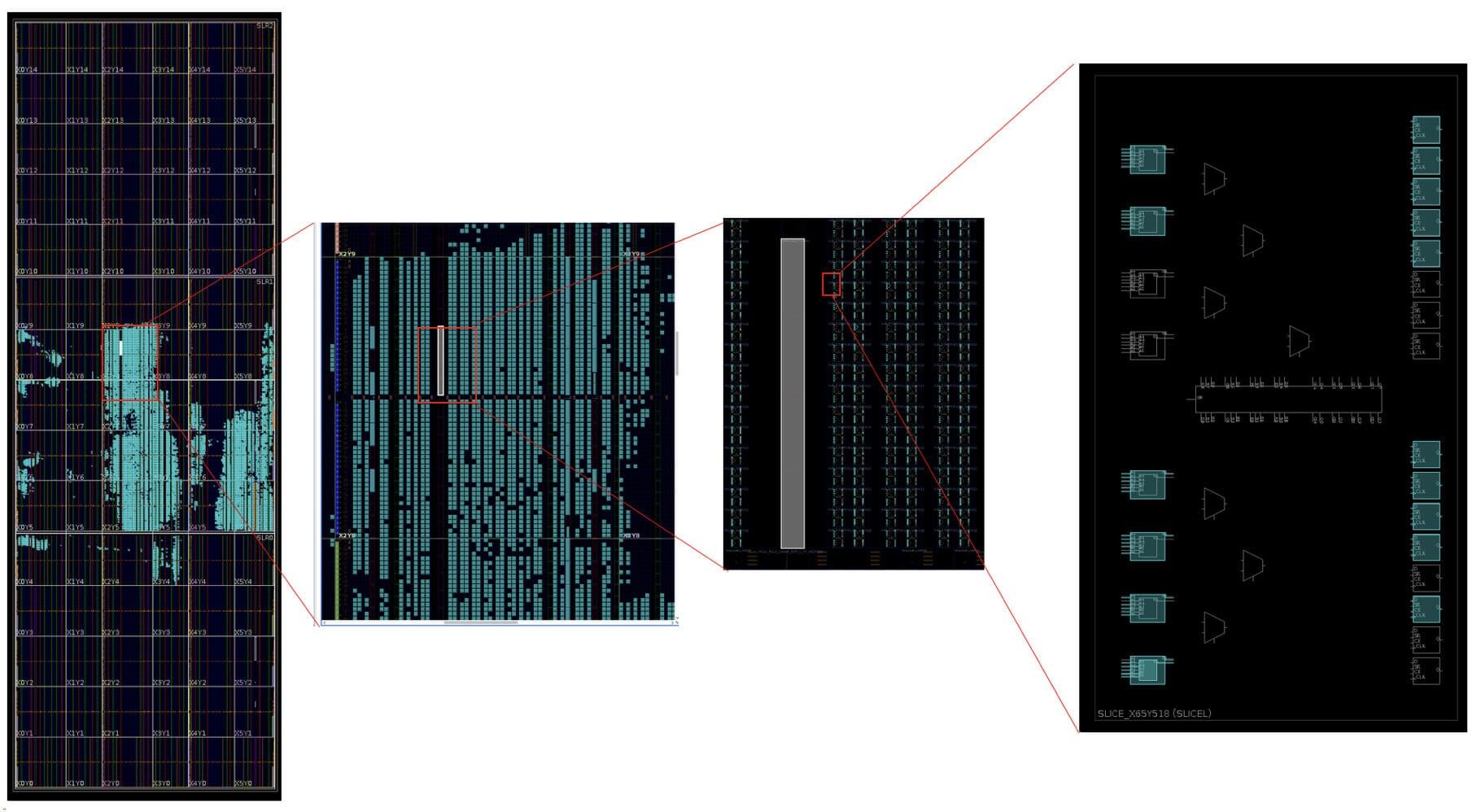
Modern trading-grade FPGA cards like the AMD Alveo UL3524 exist for one reason: ultra-low latency deterministic networking.
Key characteristics include:
- Ultra-low-latency transceivers
- Direct fibre PHY access
- Massive LUT capacity
- On-board memory optimised for pipelines
This is not GPU compute. This is network-first silicon.
What About eFPGA and Hybrid Designs?
The next evolution is embedded FPGA (eFPGA).
Instead of a standalone card:
- FPGA fabric is embedded directly into ASICs
- Latency drops further
- Power efficiency improves dramatically
This approach gives firms:
- ASIC-level performance
- FPGA-level flexibility
Perfect for:
- Exchange protocol changes
- Regulatory updates
- Strategy evolution
Once you’ve taped out an ASIC, you can’t change it.
eFPGA lets you adapt without starting over.
When FPGA Is Worth It (And When It’s Not)
Let’s be brutally honest.
FPGA Makes Sense If:
- You compete at the front of the book
- Your strategy depends on queue position
- You care about p99.9 latency
- Your flow is large enough to amortise development cost
- Your logic is streaming and deterministic
If nanoseconds equal money, FPGA wins.
CPU Is Still Fine If:
- Your edge is statistical or ML-driven
- Latency tolerance is microseconds
- You trade less crowded instruments
- Strategy iteration speed matters more than raw latency
Plenty of profitable firms still run software-only stacks.
But elite execution paths are no longer software-only.
What You Should Actually Benchmark
Don’t get fooled by marketing numbers.
Measure:
- End-to-end tick-to-trade
- p99 and p99.9, not just p50
- Behaviour under burst conditions
- Power per trade
- Failure modes under load
FPGA shines under pressure — exactly when CPUs wobble.
The Reality: This Is Already Table Stakes
The firms winning today aren’t debating FPGA.
They’re already:
- Running hybrid CPU + FPGA stacks
- Pushing more logic into silicon each year
- Treating CPUs as orchestration, not execution
This is not the future.
This is the present.
Final Word: Physics Always Wins
You can’t optimise away physics.
At some point:
- Clock cycles beat threads
- Wires beat instructions
- Determinism beats averages
FPGA is not about being “fast.”
It’s about being predictably fast — every time.
If your strategy depends on being first, software alone will eventually fail you.
Ready to Build at Hardware Speed?
At Digital One Agency, we design and deliver:
- FPGA trading pipelines
- Hybrid CPU + FPGA architectures
- Ultra-low-latency market data systems
- Deterministic execution infrastructure
From architecture to deployment — globally.
Book a Free 1-Hour Strategy Session
👉 Book a meeting
📞 Call us globally 24/7: +61 2 9057 9079
📧 Email: contact@digitaloneagency.com.au
If nanoseconds matter to your business — let’s talk.
Need Custom AI & RAG Pipelines in Australia or the UK?
Digital One Agency is a senior, founder-led engineering team based in Australia (Gold Coast HQ) with active UK clients in London, Manchester and Edinburgh. We build production RAG pipelines and bespoke AI systems — fine-tuning, vector search, evaluation harnesses included.
- Free 30-minute discovery call with a senior engineer
- Fixed-scope quote with milestone billing — no hourly rates
- AU & UK references on request
- Bespoke code you own — not a SaaS reseller, not a ChatGPT wrapper
Book your free discovery call → Or send us your project details


